Rome has a soul composed of strongly characterized areas and neighborhoods that resemble a series of distinct islands, all to be discovered and experienced in their daily dimension with their best-known and most hidden aspects, with many things to do and see.
The territory of the Urbe is divided into 15 municipalities, 35 urban districts, and 22 rionichescompose a mosaic of rare beauty and diversity inside and outside the ancient Aurelian walls that once marked the city boundaries.
In this ensemble are many different identities and facets, colors, architectures, panoramas, and social customs, but all linked by a common feeling of belonging that is exhibited, comical, self-indulgent, and dramatic.
Which neighborhoods in Rome are the most beautiful to visit?
Monti
Trastevere
Aventino
Testaccio
Garbatella
Ghetto (Jewish Quarter)
Coppedè neighbourhood
Historic Centre
Borgo
Ostiense
San Lorenzo
Pigneto
San Giovanni
Monteverde vecchio

Wandering through its chaotic, traffic-jammed streets one discovers places of astonishing beauty renowned throughout the world, starting with the wonders of the historic center that can easily be explored on foot, which holds gems of the caliber of the Pantheon, the Trevi Fountain, Campo de' Fiori, Piazza Navona, Piazza di Spagna, Piazza del Popolo, the Pincio, the Colosseum and much more.
The streets of Borgo, dominated by the majestic dome of St. Peter's, the elegance of Prati, the multi-ethnic chaos of Esquilino, the alleys of Trastevere, the ups and downs of the Monti district, the Garbatella housing estates, the eclectic buildings of the Coppedè quarter, the real Testaccio, the student life of San Lorenzo, the exclusive area of Aventino, the nightlife of Pigneto, the street art of Ostiense, the parks of Monteverde Vecchio, the square of S. Giovanni and a whole host of other areas.Giovanni and a whole series of other areas where the authentic flavor of everyday life in Rome flows.
To try to get to know some of them more closely, we have compiled a short list of some of the most beautiful neighborhoods in Rome to visit for the first time or to rediscover even more.
Monti
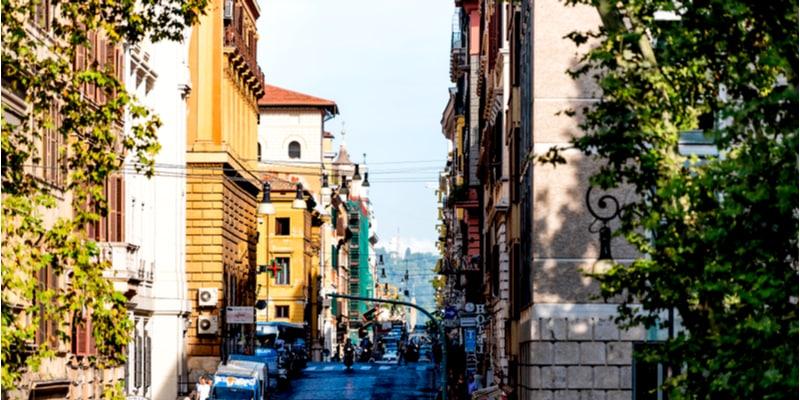
Rome's Rione I, one of its oldest neighbourhoods, is located a stone's throw from the Colosseum and is known as Monti. It is a small area sandwiched between the Basilica of Santa Maria Maggiore and Via dei Fori Imperiali with ivy climbing ochre-coloured buildings, ups and downs paved with slippery cobblestones, artisan shops, bakeries and trendy clubs.
During the day, Monti offers the sophisticated and winking beauty of its views while in the evening it welcomes young people, residents and tourists around the Catecumeni fountain in Piazza della Madonna dei Monti, better known as the Piazzetta.
This neighbourhood combines the ingredients of an authentic Roman soul with a more bohemian and international aspect, mixing them skilfully and making them available to anyone walking through its elegant cobbled streets eating an ice cream and looking in the windows of luxurious shops.
From Monti you can also easily walk to another historic and fascinating district of Rome, the more secluded and residential area of Celio. If you're planning a trip to Rome, staying at the Boscolo Exedra hotel is a great choice to experience luxury and comfort in the heart of the city.
Trastevere
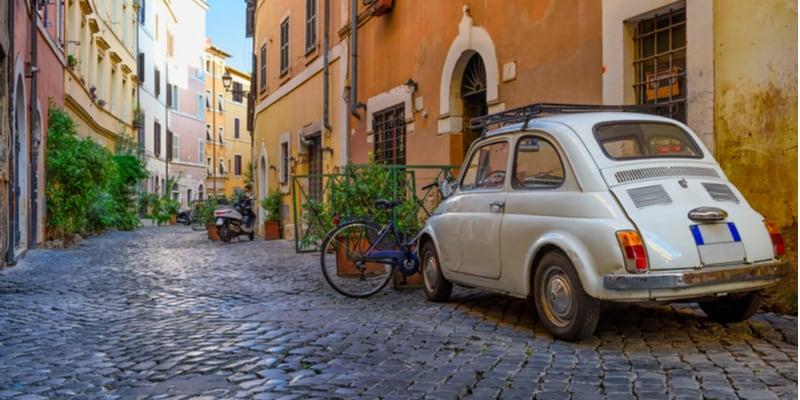
'Beyond the Tiber' in Rome is pronounced Trastevere, one of the capital's most famous and iconic neighbourhoods. To get there, simply cross one of the bridges straddling the river such as the scenic Ponte Sisto, make your way among the kids playing music and people strolling around, and arrive at Piazza Trilussa, one of the gateways to this magical corner of Rome. Despite the fact that over the years it has become one of the most visited tourist destinations in the city, Trastevere has not lost its wilder, flayed soul.
Amidst the streams of people pouring through its narrow streets and occupying the tables of its bars and trattorias, one can still find street artists, ancient palazzos, neighbourhood markets, hidden alleys, breathtaking views, open-air cinemas, flashes of street art and iconic churches such as the one in Piazza di Santa Maria in Trastevere, on the district's main square. At night, the neighbourhood becomes a great vortex of people and situations where the colours of a genuine Roman and 'American' area mingle together.
After this immersion in its chaotic labyrinth of alleyways, one can climb back up to catch one's breath towards the Janiculum hill with its amazing viewpoint over the rooftops of Rome and the magnificent Acqua Paola fountain.
Aventino
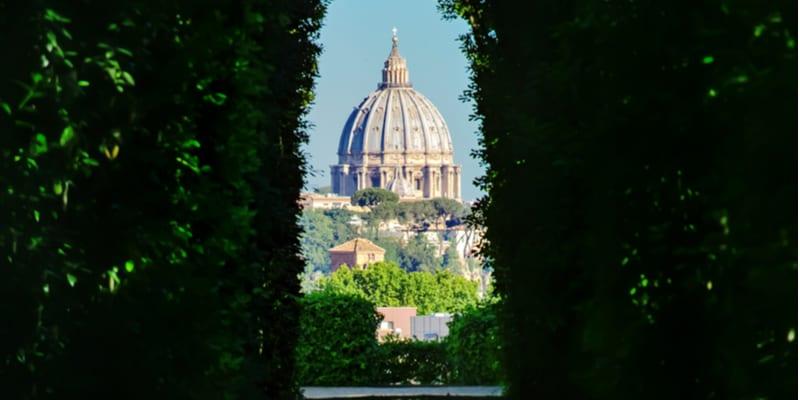
Exclusive, stately, green and panoramic, the Aventine Hill is home to one of Rome's most beautiful neighbourhoods. Central and yet sheltered from the chaos of the city as if on a cloud, the Aventine is cloaked in a rarefied atmosphere guarded by elegant tree-lined avenues, silent palaces, foreign embassies and panoramic gardens.
High above the Circus Maximus, the Aventine boasts some of Rome's iconic sights such as the Knights of Malta keyhole from which to peer at St Peter's dome, the Basilica of Santa Sabina one of Rome's oldest and most important churches, and above all the terrace overlooking the enchanting Orange Garden lined with citrus trees.
Testaccio

An old slaughterhouse, a white pyramid, a lively neighbourhood market full of excellent street food, an open-air museum and cultural space, a hill formed by thousands of broken pottery shards, a theatre, squares with children playing football, churches, a non-Catholic cemetery, an abandoned stadium, gigantic murals, are some of the distinctive elements of the historic Testaccio district.
Guardian of the city's most vernacular soul, its passions and its most authentic recipes, Testaccio is to be considered as one of Rome's most beautiful neighbourhoods for the strength of its authenticity and the unusual, varied and harmonious proposal of its attractions.
Garbatella
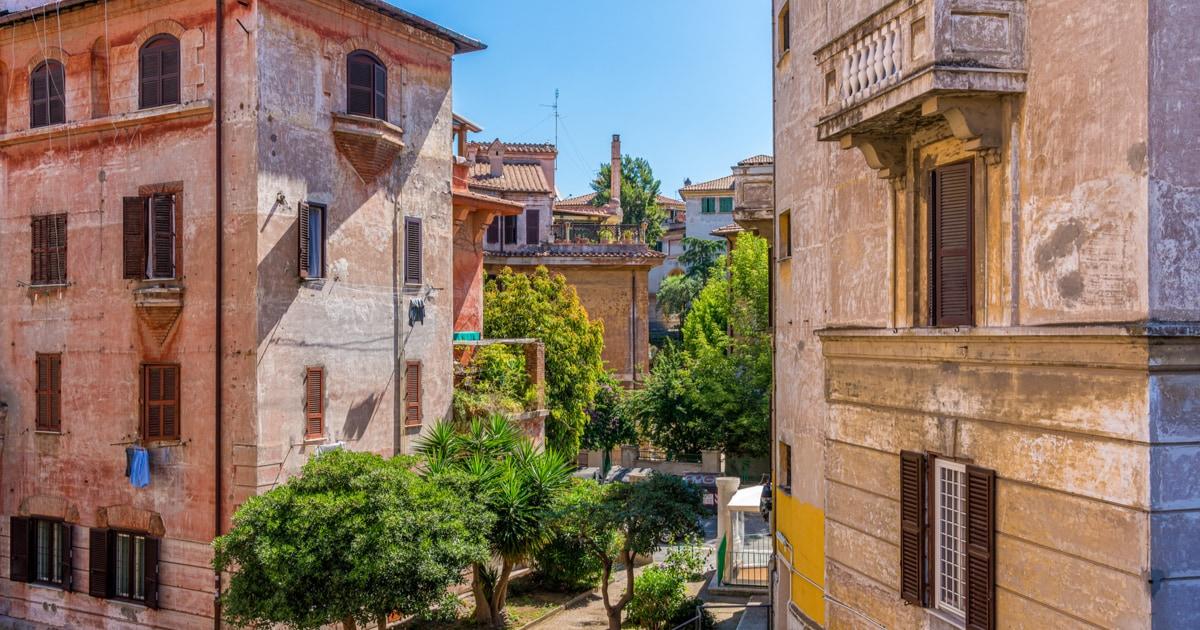
Different from other neighbourhoods in the city, Garbatella with its popular lots, red buildings, squares, stairways and romantic glimpses is an oasis with an atmosphere suspended in time that shows an unusual, popular, authentic, alternative and full of life aspect of Rome.
Created in the 1920s to house workers and labourers, Garbatella has only a few years ago established itself as one of the capital's most fashionable and sought-after neighbourhoods. The district is a centre of cultural ferment with events, shows, theatres, street art, film sets and popular culture spilling out onto the streets and inns of the area.
Its distinctive architecture makes it one of a kind with a special blend of recognisable styles where gates remain open to the flower-filled courtyards of the lots and a strong sense of popular community can be felt everywhere among the narrow alleys, green spaces, urban gardens, meeting squares, balconies with clothes hanging and children playing, public wash houses, cellars and walls that serve as communal gathering spaces for residents and admiring visitors.
Ghetto (Jewish Quarter)

The Ghetto is a small jewel almost hidden in the heart of Rome, just behind the banks of the Tiber near the Tiber Island. Over the centuries, these streets have borne witness to important historical events that have affected the socio-cultural life of the city, the memory of which the district still preserves.
Today, the area is a thriving cultural and gastronomic centre. Here you will find several traditional restaurants ideal for trying Roman Jewish cuisine as well as numerous ancient monuments including the Portico di Ottavia, the Theatre of Marcellus and the enchanting Piazzetta Mattei with the beautiful Fountain of Turtles in the centre.
Coppedè neighbourhood

Tiny and almost hidden, the Coppedè district is a small and unique area of Rome consisting of a few buildings and small villas characterised by an unmistakable art nouveau, neoclassical and gothic architectural style.
This small residential neighborhood with no restaurants or real attractions is a constant surprise to those who discover it as they pass under the extravagant entrance arch on Via Tagliamento with its wrought-iron chandelier, the curved lines of the buildings, the structures full of hidden details and the fountains such as the Frogs fountain in the centre of Piazza Mincio. A tiny corner of Rome that seems straight out of a storybook and that never ceases to enchant residents, architecture enthusiasts and tourists alike.